|
Research projects |
| |
 |
WWW-ICT
- Widening Women's Work in Information and Communication
Technology - for the European programme Information
Society Technologies (IST), fifth framework programme
of RTD (2002-2004) |
|
WWW-ICT
Why are there so few women among the professionals of
information and communication technology (ICT)? What are the barriers
to women choosing and developing careers in ICT professions, and
what changes are likely to improve their access and position in
this labour market? This European project (Information Society Technologies,
5th Framework Programme) hinges on the development of an integrated
approach to the different aspects of gender disparity in the ICT
professions. It combines explanatory factors linked to education
and training, with the conditions of work and employment, and with
the technical and professional culture of ICT. Research
teams in seven countries (Austria, Belgium, France, Italy, Ireland,
Portugal and United Kingdom) have carried out in-depth empirical
studies. They suggest targeted recommendations for agents of change
in this area.
In memoriam: Laurence d'Ouville
Laurence d'Ouville accidentally died in December 2006. She was the WWW-ICT project manager at ANACT (Lyon). Through two years of intensive collaboration, all the WWW-ICT partners appreciated her dynamism, her lucidity, her engagement for professional equality between women and men, and also her communicative enthousiasm and jovial character. Laurence is co-author of most WWW-ICT publications. Particularly she designed the awareness leaflets. We share the sorrow of her family and friends and we want to pay her a tribute through this web site.
Downloadable documents: final products
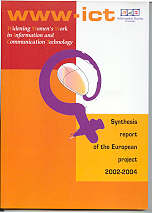
Final synthesis report
 |
Valenduc G., Vendramin P., Guffens C. (FTU), Ponzellini A.M.,
Lebano A. (FRPS), D'Ouville L., Collet I. (ANACT), Wagner
I., Birbaumer A., Tolar M. (TUW), Webster J. (RCWE), Widening
Women's Work in Information and Communication Technologies,
final synthesis report, European Commission (IST-2001-34520),
July 2004 (148 pp.)
Downloadable in two PDF versions: electronic
version of the printed document (736 kB) or active
PDF document with bookmarks (882 kB, compressed)
Single free copies of the paper version of the final synthesis
report are available on request by e-mail to the project
coordinator, at postage costs: 2.20 € in Belgium,
5.65 € in Europe, 8.95 € outside Europe. Please
indicate clearly your postal address. |
Awareness leaflets (also web version in French)
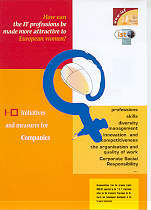
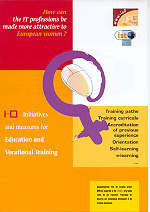
A series of three 6-pages leaflets ainming at presenting
research conclusions and recommendations for three groups of "agents
of change": enterprises and their business partners; institutions
for education and vocational training; women's associations, trade
unions and institutions for equal opportunities.
 |
 |
 |
Printed versions of awareness leaflets are available
on request by e-mail: in French to FTU
in Belgium; in English to RCWE
or FTU; in German
to TUW and in
Italian to FRPS. |
|
Leaflet for companies, human
resource managers, recruiters, etc. |
Leaflet for schools and universities,
training providers and lifelong learning institutions |
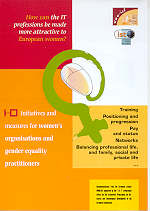
Leaflet for women's associations,
women's groups in trade unions, organisations for equal opportunities |
|
Conclusions and recommendations
Conclusions are presented under four headings: education
and training; women's working conditions; labour market and labour
relations; women's trajectories. Recommendations start from the
question: what are the conditions that can make ICT professions
and careers more attractive for women? The document briefly describes
the steps leading from conclusions to recommendations. Then it presents,
in a synoptic view, the recommendations, the concerned agents of
change, and example of good practices supporting the relevance of
the recommendations. Recommendations are finally detailed according
to different European policy areas.
The document is an excerpt of the final synthesis report, downloadable
in PDF format (46 pp.)
Downloadable documents: scientific reports
Inventory and analysis of good practices
Final version: February 2004. This report summarises
and analyses the information gathered on good practices aimed at
improving women's place in ICT professions in Europe. After an introductory
comment on the definition criteria of "good" practices,
chapter I presents a structured overview of collected good practices,
highlighting their key formal characteristics and situating them
with regard to the variety of ICT professions. Chapter III draws
some avenues for development and evolution of these practices, stressing
the importance of driving forces and mobilising initiators. Chapter
IV develops methodological recommendations related to quality criteria
and evaluation process of good practices in this area. Chapter V
draws conclusions and recommendations, and summarises the key arguments
supporting the recommendations. Seven annexes present inventories
of selected good practices in Austria, Belgium, Germany, Switzerland,
Italy, France and the UK.
The full report is downloadable
in PDF format (118 pp. including annexes). Annexes are published
together the body text, as they provide quite practical, concrete
and useful information on the collected good practices.
Case studies of work organisation
Final version: February 2004. The report presents the
analysis and synthesis of 14 sectoral overviews and 28 case studies
of enterprises in two sectors (computer services and e-publishing)
and seven countries. Chapters I and II are respectively devoted
to a comparative analysis of work and employment in the computer
services industry and the e-publishing industry, with an emphasis
on social aspects and gender issues. Chapter III describes the case
study analysis in computer services and chapter IV in e-publishing.
Chapter V highlights some national and contextual issues related
to women's work in these sectors across Europe. Chapter VI presents
conclusions under two main headings: labour markets; organisational
structures and practices.
This synthesis report is downloadable
in PDF format (124 pp. including annexes summarising the main
features of case studies). Detailed reports on sectoral overviews
and case studies in each country will be made available on request
by e-mail to the project
coordinator.
Professional trajectories and biographies
First final version: January 2004. The report starts
presenting the conclusions from the biographical interviews, as
a 12-pages executive summary. The next chapter analyses more precisely
the key characteristics and varied profiles of women's biographies
in ICT. The third chapter draws eight clusters of career patterns
for women in ICT, based on a multi-criteria analysis of the coded
biographical sheets gathered by the seven research teams in their
country. The fourth chapter accounts for a more in-depth qualitative
analysis of life-story patterns. The fifth chapter comments specific
aspects of the male biographies and stresses the common and different
points as regards female biographies. Annex 1 contains the seven
synthesis reports on biographical interviews in each country. Annex
2 summarises the quantitative analysis of the coded biographical
sheets and explains the methodology of cluster analysis.
Two versions are downloadable in PDF format: the full
version, including the annexes (274 pp.) and a "light"
version, containing chapters 1-5 without the annexes (68 pp.).
Conceptual framework and state of the art
(September 2002, updated April 2003, English, 156 pp.,
downloadable PDF file)
This report describes the various dimensions of gender disparties
in ICT professions and discusses a set of interacting explicative
factors. It relies on a state of the art of existing research in
this area.
Bibliography
(November 2002, updated January 2004, on-line
version)
A customised search engine allows for consultation and retrieval
of the on-line bibliography.
Downloadable documents: articles
Gérard Valenduc, Patricia Vendramin
Work organisation and skills in ICT professions: the gender dimension
Conference "ICT, the knowledge society and changes in work", Den Haag, June 2005
Gérard Valenduc, Patricia Vendramin, Caroline Guffens
La place des femmes dans les métiers des TIC
Revue Wallonie, n° 80, Liège, septembre 2004
Project partners WWW-ICT
Project co-ordinator
Fondation Travail-Université (FTU)
Work & Technology Research
Centre
Rue de l'arsenal 5, B-5000 Namur, BELGIUM
Project co-ordinators: Patricia Vendramin (pvendramin@ftu-namur.org)
and Gérard Valenduc (gvalenduc@ftu-namur.org)
Project partners
National Agency for the Improvement of Working Conditions
(ANACT)
4 Quai des Etroits, F-69321 Lyon cedex 05, FRANCE
Project manager: Laurence D'Ouville
Vienna University of Technology (TUW), Institute
for Technology Assessment and Design
Argentinierstrasse 8, A-1040 Wien, AUSTRIA
Project manager: Ina Wagner (iwagner@pop.tuwien.ac.at)
Fondazione
Pietro Seveso
Viale Vittorio Veneto 24, I-20124 Milano, ITALY
Project manager : Anna Ponzellini (ponzmi@tin.it)
Research and Consultancy in Work and Employment
22 Northchurch Terrace, London N1 4EG, UK
Project manager: Juliet Webster (equality.research@debeauvoir.co.uk)
Sub-contractors
University of Lisbon, Centre for Social Research and
Intervention (CIS)
ISCTE, Av. Forças Armadas, P-1649 Lisboa 026, PORTUGAL
Project manager: Paula Castro (paula.castro@iscte.pt)
Trinity College, Employment Research Centre (ERC)
1, College Green, Dublin, IRELAND
Project manager: James Wickham (jwickham@tcd.ie)
European Conference
Women's place in ICT professions
Paris, 24 May 2004
Conference programme and downloadable presentations
Morning sessions: research results and outcomes
Chair: Gérard Valenduc, Work & Technology Research Centre,
Fondation Travail-Université, Namur, Belgium.
Session 1: What is ICT work for women really
about?
Women's jobs in ICT cover a wide range of professions
and functions, including project management, programming, multimedia
design and support, marketing and customer support. There are neither
"women excluded" nor "women only" jobs, except
that high level management functions are rarely accessible to women.
The image of women working in ICT has to be reshaped.
Presentation of WWW-ICT findings, by Ina Wagner, Institute for
Technology Design and Assessment, Vienna University of Technology,
Austria (PDF version)
Session 2: How to improve women's choices
and careers in IT?
Women enjoy working with ICT. Technology is not
really a barrier to their entry into ICT curricula and careers.
Women's entry routes are very diverse, including technical and non-technical
degrees, and late entry through lifelong learning. Obstacles and
opportunities in women's careers in ICT depend strongly on organisational
choices at company level. Balancing career and private or family
life are a matter of individual choice and work organisation.
Presentation of WWW-ICT findings, by Juliet Webster, Research
and Consultancy on Work and Employment, London, UK (PDF
version)
Afternoon sessions: pathways for change
Chair: Patricia Vendramin, Work & Technology Research Centre,
Fondation Travail-Université, Namur, Belgium.
Session 3: Why still so few women
in ICT after so many years of campaigns?
For many years, various campaigns have been initiated
to attract more women in ICT professions. Why is their success apparently
so limited? Too often, they address only women, neglecting other
agents of change. Their messages concerning job content and careers
are too vague. And they often focus on only one of the causes of
the gender gap in ICT professions: either education or working conditions
or professional culture.
Presentation of WWW-ICT findings, by Laurence
D'Ouville, National agency for the improvement of working conditions
(ANACT), Lyon, France, and Isabelle Collet, University of Paris
X Nanterre
(PDF version)
Session 4: How to improve women's place
in ICT professions?
Final recommendations of WWW-ICT address a range
of topics: a better understanding of the variety of ICT professions;
more concern for career choice and reorientation; an increased effort
in continuous training; changes in work organisation allowing for
a better balance between working time and other social times; more
attention by human resource managers to coaching, mentoring and
targeted family-friendly policies; support for women's networks;
progress in labour market policies and equal opportunities policies.
Presentation of WWW-ICT recommendations, by Anna Ponzellini,
Fondazione Regionale Pietro Seveso, Milan, Italy (PDF
version)
Workshop "Gender and ICT professions"
(Brussels, 29 September 2003)
Workshop programme and downloadable presentations
General presentation of WWW-ICT, structure and
objectives of the workshop
Woskshop moderator: Gérard
Valenduc, Fondation Travail-Université (B)
Session A: Human resource management
- Specificities of career management, opportunities and disadvantages
for women
Juliet
Webster, Research and Consultancy on Work and Employment,
London (UK)
- Knowledge management: self-training and ongoing development
of competences
Caroline Guffens,
Fondation Travail-Université, Namur(B)
- Comments on social relations: women and the individualisation
of work relation
Patricia Vendramin,
Fondation Travail-Université, Namur (B)
Session B: Quality of work
- Time management, relation to working time: obstacles and opportunities
for women
Patricia Vendramin,
Fondation Travail-Université, Namur (B)
- Job content: preferences, attitudes, expectations and frustrations,
what are the women's choices
Juliet Webster,
RCWE, London (UK)
- Professional culture and work organisation: how do women behave?
Adele Lebano,
Fondazione Regionale Pietro Seveso, Milano (I)
Session C: Women's trajectories into ICT: dynamics,
paths and patterns
Session D: Labour market
- Diversification of job profiles: an increasing place for women
?
Juliet Webster,
RCWE, London (UK)
- Relation of women to the specific labour market of ICT jobs
Anna Ponzellini,
Fondazione Regionale Pietro Seveso, Milano (I)
Session E: Good practices and recommendations
- Characterisation of existing good practices for equal opportunities
in ICT professions
Laurence D'Ouville, Agence nationale pour l'amélioration
des conditions de travail, Lyon (F)
- Pathways for recommendations
Patricia Vendramin, Fondation Travail-Université (B)
Workshop "Gender and ICT professions in IST
projects and European policies" (Brussels, 21 October 2002)
Workshop programme and downloadable presentations
Welcome address
Heidi Seybert, project officer, IST programme
Presentation of WWW-ICT and the goals and structure of the
workshop
Patricia Vendramin,
Fondation Travail-Université (B)
Focus 1: Gender and ICT professions: problems and limits of
quantitative and qualitative approaches to the gender gap
- Mapping the ICT professions, mapping the gender gap: findings
and methodological issues
Gérard
Valenduc, Fondation Travail-Université (B)
- Gender approaches in European socio-economic research on the
Information Society
Juliet Webster, Research
and Consultancy on Work and Employment (UK)
- Contributions from other IST projects and EC initiatives:
Jane Millar (SPRU Brighton,
STAR project)
Monique Ramioul
(HIVA Leuven, STILE and EMERGENCE
projects)
Frank Noël (ICT-skills
monitoring group, DG Enterprise)
Focus 2: The role of cultural, psychological and
educational factors in gender disparities in ICT professions
- Contributions from WWW-ICT: Andrea
Birbaumer, Technische Universität Wien (A), and Caroline
Guffens, Fondation Travail-Université (B)
- Contributions from other IST projects and EC initiatives
Vivian Berg (SIGIS project)
Nancy Pascall (DG Information Society) and Maria Douka (Unit Women
and Science, DG Research)
Focus 3 - Work organisation and working conditions
in ICT professions: limited space for women's careers
- Contribution from WWW-ICT: Anna
Ponzellini, Fondazione Pietro Seveso (I)
- Contributions from other IST projects and EC initiatives
Richard Wynne (WRC Dublin,
FAMILIES project)
Monique Ramioul
(HIVA Leuven, STILE and EMERGENCE projects)
Detlef Gerhardt (Unit
Knowledge Society and ESDIS, DG Employment)
Conclusions and perspectives
- Futures tasks of WWW-ICT and planned dissemination activities
(workshops, publications)
Gérard Valenduc,
Fondation Travail-Université (B)
Useful links
Women and ICT occupations
- Belgium: the ADA project,
supported by the European Social Fund and the Belgian Ministry
of Labour and Equal Opportunities, builds up a network of initiatives
about women and ICT: training, job opportunities, equal opportunities,
etc. The ADA web site also contains hyperlinks with other similar
projects in Europe. ADA partners are involved in the organisation
of the Digitales
days, a yearly international event on women and ICT, held in Brussels
(last events: December 2002 and January 2004).
European programmes and projects
- The SIGIS project
(Strategies for Inclusion of Gender in the Information Society)
is another IST project concerning gender issues in ICT. SIGIS
addresses women as ICT users, at work and in everyday life, while
WWW-ICT focusses on women in ICT professions. Most of the SIGIS
reports are already available on-line.
- The STILE project (Statistical
Indicators on the Labour Market in the e-economy) contains relevant
gendered data on women employment and labour market in the e-economy.
- The final results of EMERGENCE
(Estimation and Mapping of Employment Relocation in a Global Economy
and New Communications Environement) emphasise some gender aspects
in e-work and work relocation.
- More information on socio-economic research within the European
programme Information Society Technologies:
http://www.cordis.lu/ist/ka2/ser.htm
- European Commission, Unit "Women and science":
http://www.cordis.lu/improving/women/home.htm
- ICT skills monitoring group and e-Skills forum:
http://europa.eu.int/comm/enterprise/ict/policy/ict-skills.htm
|